Designing Learning Spaces for Innovation
How do you go about creating a space to support collaboration, creative problem-solving and innovation? Two institutions share their experiences.
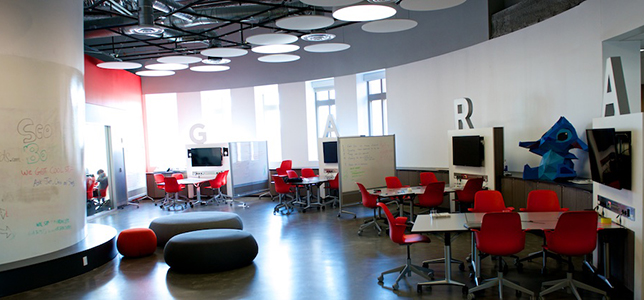
USC's "Garage" space features flexible classrooms, maker facilities and spaces for collaboration. (photo courtesy of USC / D. Quistorf)
Susan Metros vividly remembers the blank slate that would become the "Garage," a new learning space for the University of Southern California's Iovine and Young Academy for Arts, Technology and the Business of Innovation. In 2013, entrepreneurs Jimmy Iovine and Dr. Dre (aka Andre Young) had given $70 million to create a unique undergraduate program that promotes new kinds of learning through cross-disciplinary and hands-on discovery, in a fully immersive and collaborative learning space. The space for the new program, on the fourth floor of the Ronald Tutor Campus Center, was completely undeveloped.
"I remember going to a meeting and there was no electricity," said Metros, associate dean of the academy. "We really got to start from scratch." The space was an open canvas for innovation, yet the timeline was aggressive — with only three months for design and five months for construction.
Rethinking Design
Members of the design team, including the dean, traveled to look at other universities' innovation spaces and makerspaces, as well as spaces in the Newseum in Washington, D.C. In her previous position as vice provost of technology-enhanced learning, Metros had led a group charged with reimagining learning spaces on USC's campus. "We knew we didn't want a classroom with four walls or a lecturer in front," she said. "We knew we wanted to have students be in a classroom where if the faculty member posed a question or challenge, the students could go and make something and bring it back to class, and not have to wait until the next week. Rapid iteration was paramount in terms of creative problem-solving and design thinking. From the beginning we knew the space had to be flexible, so that students could learn, make things and collaborate, and it had to be a place where creativity could evolve. Our dean calls it 'accidental collisions.'"
In the Garage
USC's ultramodern Garage space includes:
- High-powered computer docking stations loaded with cutting-edge software used in all areas of design as well as in the entertainment and audio industries;
- A "pitch" room for teleconferencing and remote instruction, dominated by a long conference table large enough to seat the entire class;
- Two fabrication areas with 3D printers and scanners that allow students to print in high-definition plastics and powders;
- A workshop stocked with hand tools, power tools, electronics, etc.;
- Two classrooms, one with work-friendly beanbag chairs;
- A kitchenette and lounge for hanging out; and
- An expansive balcony overlooking the Tutor Campus Center courtyard.
Metros said it was important to find an architecture firm that was receptive to a different design process. USC worked with Steinberg Architects, which came in and created "mood boards" to cluster design ideas. "Instead of saying we want a place to do 3D printing or a place for students to sit and talk, we turned it around and said what is the feeling we would like," Metros explained. Vetting those ideas turned out to be a challenge: Since the team was designing the space before the program started, there were no current students to offer feedback (although a few design students participated).
There were also some ideas, such as movable walls, that were deemed too expensive or impractical, Metros said. "I learned the term 'value engineering': We called it design and they called it embellishments."